
Understanding how to use a multimeter is one of the most valuable skills in basic electrical troubleshooting. Whether you’re diagnosing a faulty outlet, checking a car battery, or verifying continuity in a circuit, a multimeter gives you accurate electrical measurements quickly and safely.
A multimeter measures voltage, current, and resistance, and many modern digital multimeters (DMMs) also test continuity, diodes, frequency, and temperature. From homeowners and DIY enthusiasts to professional electricians and automotive technicians, this tool is essential for safe and effective diagnostics.
In this comprehensive guide, you’ll learn how to use a multimeter correctly, how to test voltage, how to use a multimeter to test a car battery, how to check continuity, how to test an outlet, and much more. We’ll also cover safety best practices aligned with guidelines from organizations like Occupational Safety and Health Administration and National Fire Protection Association.
What Is a Multimeter and How Does It Work?
A multimeter is a handheld measuring instrument used to test electrical properties such as AC voltage, DC voltage, resistance (ohms), and current (amps). It combines multiple measurement tools into one device, making it indispensable for electrical troubleshooting.
Modern digital multimeters display readings on an LCD screen and provide higher accuracy compared to older analog versions. Some advanced models even include auto-ranging, non-contact voltage detection, and data logging.
Understanding how a multimeter works internally helps users interpret readings more accurately and avoid misdiagnosing electrical issues.
Key Points About Multimeters
• A multimeter works by connecting test probes to a circuit and measuring the electrical potential difference, resistance, or current flow. The device internally converts the electrical input into digital data that appears on the screen, allowing precise diagnostics even in small circuits.
• There are two primary types: analog multimeters and digital multimeters (DMMs). Digital models dominate today’s market due to accuracy, reliability, and easier reading, especially in automotive and residential electrical systems.
• The selector dial determines the measurement type—AC voltage (V~), DC voltage (V⎓), resistance (Ω), continuity, and amps (A). Choosing the correct setting is critical to prevent incorrect readings or internal fuse damage.
• Test leads consist of a red (positive) probe and black (common/ground) probe. The black lead typically plugs into the COM port, while the red lead goes into voltage/resistance or current input ports depending on measurement needs.
• Safety ratings such as CAT III or CAT IV indicate the device’s ability to handle high-energy circuits. Always check category ratings when working with household mains power.
• Auto-ranging multimeters automatically select the correct measurement range, reducing user error and making them ideal for beginners learning how to use a multimeter safely.
Multimeter Safety Guidelines Before You Start
Before learning how to use a multimeter to test voltage or check continuity, safety must come first. Electrical systems can be dangerous, particularly when testing outlets or automotive components.
Following proper safety standards minimizes risk of electric shock, short circuits, and equipment damage. Professional electricians strictly adhere to established electrical safety practices.
Essential Safety Practices
• Always inspect test leads for cracks, exposed wires, or damaged insulation before use. Faulty probes can expose you to live voltage and increase shock risk significantly.
• Confirm the dial is set correctly before touching probes to a circuit. Setting resistance mode while measuring live voltage can destroy the meter’s internal circuitry.
• Use one hand when testing high-voltage systems to reduce the risk of current passing through your chest in case of accidental contact.
• Wear insulated gloves when testing live outlets or breaker panels. Personal protective equipment significantly reduces electrical hazards.
• Never exceed the voltage rating printed on your multimeter. Overloading the device can cause internal damage or even explosion in extreme cases.
• Disconnect power when checking resistance or continuity. Continuity tests must never be performed on energized circuits.
Also Read:- How to Transfer Photos from iPhone to Computer (Complete 2026 Guide)
How to Use a Multimeter to Test Voltage
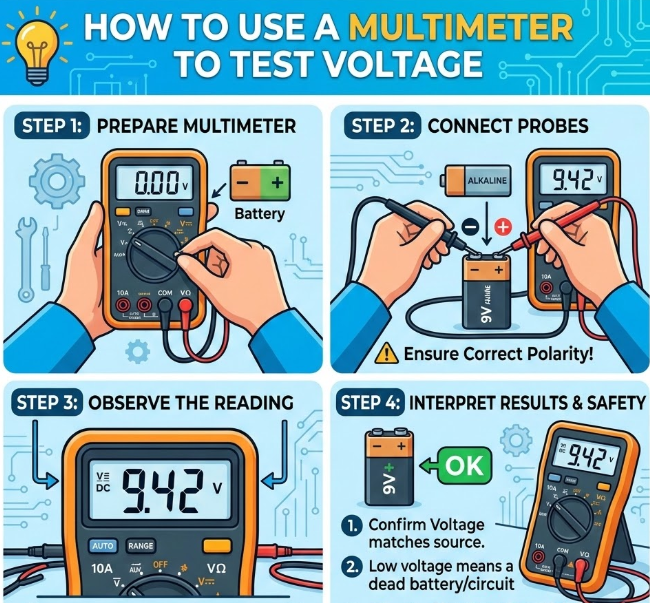
Learning how to use a multimeter to test voltage is the most common application. Voltage testing determines whether power is present in a circuit, battery, or outlet.
Voltage can be AC (alternating current) in homes or DC (direct current) in batteries and vehicles. Selecting the correct setting ensures accurate measurement.
Steps to Test Voltage
• Insert the black probe into COM and red probe into the VΩ port. This ensures correct measurement mode for voltage and resistance testing.
• Turn the dial to AC voltage (V~) for outlets or DC voltage (V⎓) for batteries. Choosing the wrong type leads to inaccurate readings.
• Place the black probe on neutral or negative and red probe on live or positive terminal. Maintain steady contact for stable readings.
• Read the display. Standard U.S. outlets show approximately 120V AC, while many countries show 220–240V AC.
• For DC batteries, compare readings with manufacturer specifications. A fully charged 12V battery typically reads around 12.6V.
• Remove probes carefully and turn the dial off after use to preserve battery life and prevent accidental misuse.
Also Read:- How to Make a Roux: The Ultimate Guide for Perfect Sauces and Gravies
How to Use a Multimeter to Test a Car Battery
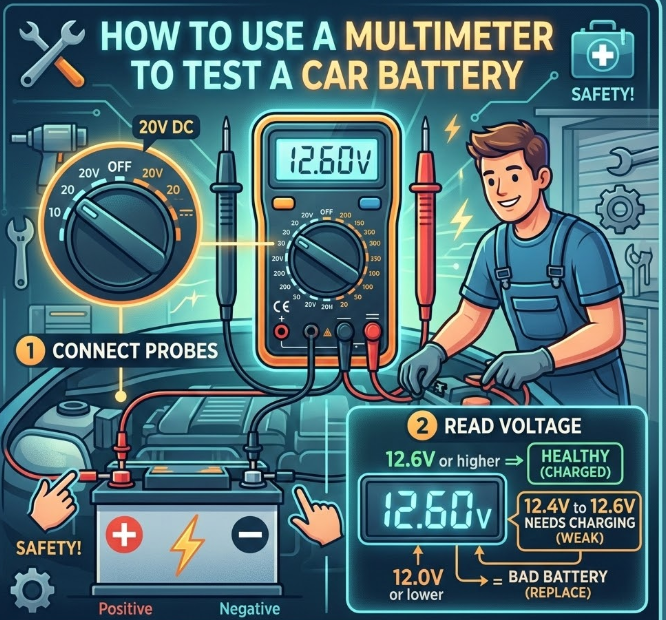
Understanding how to use a multimeter to test a car battery helps prevent unexpected breakdowns. Automotive electrical diagnostics rely heavily on accurate DC voltage testing.
Car batteries degrade over time, and a multimeter quickly identifies weak charge levels before failure occurs.
Car Battery Testing Process
• Set the dial to DC voltage (20V range if manual). This range accommodates 12V automotive batteries safely.
• Connect red probe to the positive terminal and black probe to the negative terminal. Ensure firm metal contact.
• Check the reading: 12.6V indicates full charge; 12.4V suggests partial charge; below 12.0V indicates a weak battery.
• Start the engine and measure again. Voltage should rise to around 13.7–14.7V, confirming alternator function.
• If voltage drops significantly under load, battery replacement may be necessary.
• Clean terminals before testing to ensure corrosion doesn’t affect readings.
Also Read:- How to Make a Roux: The Ultimate Guide for Perfect Sauces and Gravies
How to Use a Multimeter to Test an Outlet
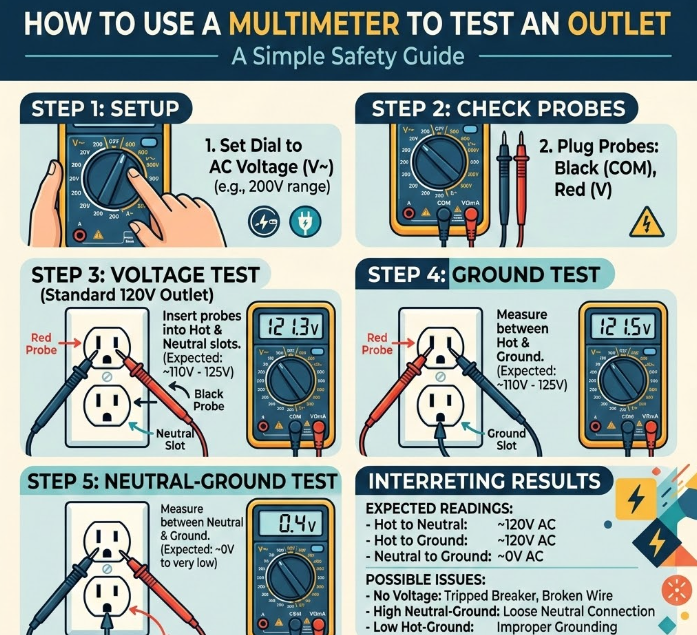
Knowing how to use a multimeter to test an outlet ensures your household wiring delivers safe power levels. Outlet testing identifies wiring faults, loose connections, or voltage irregularities.
Outlet Testing Procedure
• Set dial to AC voltage (V~) above expected voltage rating.
• Insert black probe into the neutral slot (larger slot) and red probe into the live slot.
• Confirm reading matches your region’s standard voltage (120V or 230V).
• Test live to ground to confirm proper grounding.
• If voltage fluctuates drastically, consult a licensed electrician.
• Never touch metal probe tips during testing to prevent shock.
Also Read:- How to Cook a Ham: The Complete Guide for Oven, Crock Pot, Roaster, and Ham Steak
How to Use a Multimeter to Check Continuity
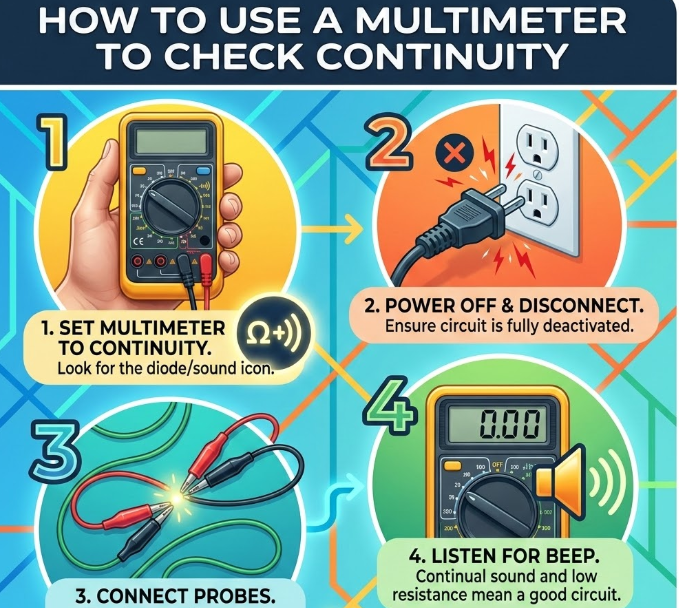
Learning how to use a multimeter to check continuity helps detect broken wires and faulty switches. Continuity testing determines if electricity flows freely through a path.
Continuity Testing Steps
• Turn off power completely before starting the test.
• Set dial to continuity mode (often symbolized by sound wave icon).
• Touch probes together to confirm beep sound indicating working function.
• Place probes at opposite ends of wire or circuit.
• A beep or near-zero resistance indicates continuity.
• No sound or infinite resistance means broken circuit.
Also Read:- How to Cite a Book: The Complete Academic Guide for MLA, APA, and Research Papers
How to Use a Multimeter on a Car
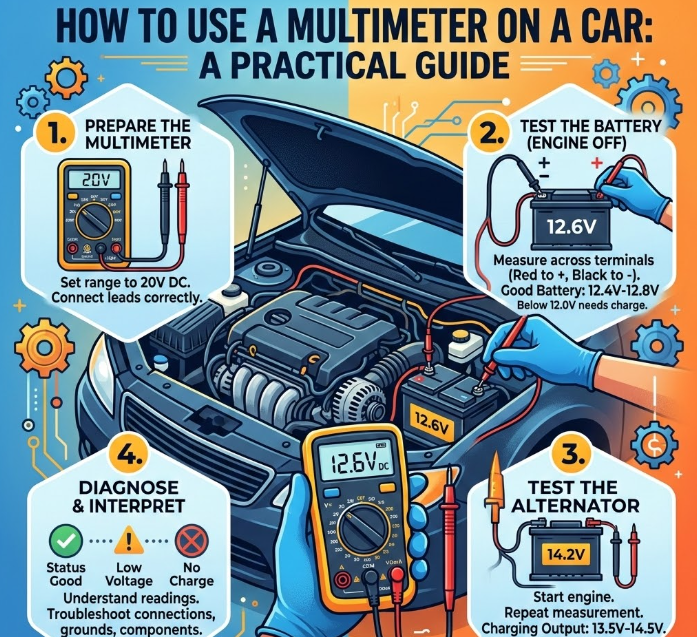
Understanding how to use a multimeter on a car extends beyond battery testing. Automotive diagnostics include checking fuses, alternators, and sensors.
Automotive Applications
• Test fuses by checking continuity across fuse terminals.
• Measure alternator output voltage while engine runs.
• Check parasitic drain by measuring current draw.
• Inspect ignition coils for resistance values.
• Diagnose faulty wiring in lighting circuits.
• Verify grounding connections to prevent electrical glitches.
Also Read:- How to Press Flowers: A Complete Step-by-Step Guide
How to Use a Multimeter to Check for Power
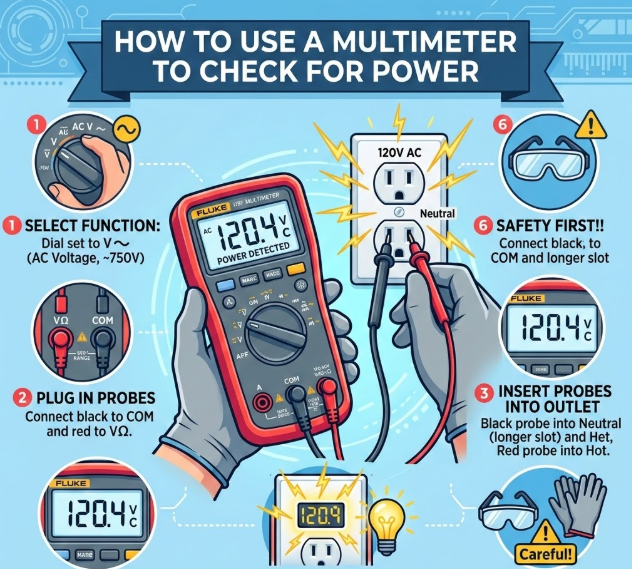
If you suspect a device isn’t receiving electricity, learning how to use a multimeter to check for power confirms presence or absence of voltage.
Power Checking Steps
• Set meter to appropriate AC or DC voltage.
• Identify positive and negative terminals safely.
• Place probes carefully while maintaining insulation grip.
• Observe voltage reading on screen.
• Compare reading with expected device requirement.
• Remove probes safely after confirmation.
Also Read:- How to Paint Kitchen Cabinets: Complete Step-by-Step Guide for a Professional Finish
Common Multimeter Mistakes to Avoid
• Using resistance mode on live circuits.
• Plugging red probe into amp port accidentally.
• Ignoring safety category ratings.
• Not zeroing manual range meters properly.
• Testing current incorrectly without series connection.
• Forgetting to turn off the device.
Conclusion
Mastering how to use a multimeter empowers you to diagnose electrical problems confidently and safely. From testing voltage and checking continuity to evaluating car batteries and verifying outlet power, this tool provides reliable measurements essential for troubleshooting.
By following proper safety standards, understanding dial settings, and practicing consistent testing methods, even beginners can develop professional-level diagnostic skills. Always prioritize safety, double-check settings, and consult licensed professionals for high-voltage systems.
FAQs
Can a multimeter detect live wires?
Yes, by testing AC voltage, it confirms presence of live current.
What voltage should a 12V battery show?
Approximately 12.6V when fully charged.
Is continuity mode safe on live circuits?
No, never test continuity on energized circuits.
What is the difference between AC and DC voltage?
AC alternates direction (household power), DC flows in one direction (batteries).
How accurate are digital multimeters?
Most modern DMMs provide accuracy within ±0.5% depending on model.
For More Update Visit: VallayTaxNv